Why Is My Lawn Turning Brown in July? Common Causes in Missouri
If your lawn is turning brown in July, it does not automatically mean the grass is dead or that a lawn treatment failed. Missouri summer lawns can turn brown because of heat and drought stress, temporary dormancy, uneven watering, mowing damage, compacted soil, disease, grub activity, or several problems happening at the same time.
The pattern often tells us as much as the color.
At AmeriLawn, our licensed application technicians work with lawns across Southwest Missouri every season, and we know that two brown lawns can look similar while having completely different problems. A brown strip along a Republic driveway may have a different cause than an irregular patch spreading through a Nixa backyard.
With more than 25 years of regional pesticide and herbicide experience behind our team, we look at what is happening across the property before recommending the next step.
Is Brown Grass in July Dead, or Could It Just Be Dormant?
Brown grass is not automatically dead. Cool-season grasses commonly grown in Missouri can slow their growth or enter dormancy when prolonged heat and limited moisture put the turf under significant stress.
The University of Missouri Extension notes that tall fescue and Kentucky bluegrass can survive periods of summer dormancy under many conditions, even though their appearance may decline. Tall fescue often stays green longer because of its deeper root system. Learn more about summer care for cool-season Missouri lawns.
What Does Heat-Stressed Grass Look Like?
Heat stress often becomes visible before the lawn turns completely brown.
The turf may lose its bright green color and take on a dull or gray-green appearance. Grass blades may wilt or fold, growth may slow, and footprints can remain visible after someone walks across the yard.
Large sunny areas may also begin fading before shaded sections.
The important difference is that stressed or dormant grass can still be alive at the crown and root level.
How Can You Tell Whether Brown Grass Is Still Alive?
Look beyond the top of the grass.
Check near the base of the plant for green tissue. Compare the brown area with healthier turf nearby. Notice whether the grass remains firmly rooted and whether the color changed gradually across a large section or appeared quickly in distinct patches.
No single test tells the whole story. When we evaluate summer browning, we look at the pattern along with the roots, soil moisture, recent weather, and how the lawn has been maintained.
Why You Should Not Immediately Assume a Lawn Treatment Failed
July often exposes weaknesses that were harder to see during spring.
A lawn may look healthy when temperatures are mild and rainfall is more frequent, then begin struggling when summer reveals shallow roots, thin turf, compacted soil, poor irrigation coverage, or previous damage.
That is one reason AmeriLawn uses customized lawn treatment plans rather than treating every property exactly the same. The brown grass may be the visible symptom, while the underlying issue is happening in the soil, roots, or maintenance routine.
What Are the Most Common Reasons Missouri Lawns Turn Brown in July?
Several lawn problems can look almost identical from across the yard. Before deciding what the lawn needs, it helps to narrow down the most likely causes.
1. Heat and Drought Stress
Heat and drought are among the most common reasons Missouri lawns lose color during summer.
As temperatures rise and soil dries, turf loses moisture faster. Grass growing in full sun or with a weaker root system often shows stress first.
You may notice large areas gradually fading, grass blades wilting, or footprints remaining visible longer than normal.
Even tall fescue, which generally handles dry conditions better than some other cool-season grasses, can lose color during extended summer stress.
This can be especially noticeable in exposed lawns throughout South Springfield and other developed areas where turf receives long periods of direct summer sun.
2. Uneven or Incorrect Watering
A lawn can be watered regularly and still have dry areas.
Sprinklers do not always distribute water evenly. Water may run off slopes or compacted soil before reaching the root zone, while turf near pavement or in full afternoon sun can dry faster than other sections.
That is why “Why is my lawn brown even though I water it?” does not have one universal answer.
Sometimes the issue is not how long the sprinkler runs. It is whether enough water is actually reaching the roots in the area that is struggling.
The right watering approach depends on the grass, soil, sun exposure, recent rainfall, and condition of the root system.
3. Mowing Too Short During Summer Heat
A mowing routine that worked well during spring can add stress during July.
Cutting cool-season grass too short reduces the amount of leaf surface available to support the plant and leaves the soil and turf crown more exposed to summer conditions. Uneven ground can also be scalped when the mower deck passes over a high spot.
One mistake we often see is removing too much grass at once because summer growth has become uneven. When the turf is already stressed, an aggressive cut can make the lawn look significantly worse.
Dull mower blades can add another problem by tearing the grass instead of making a cleaner cut.
4. Heat Stress Along Driveways, Sidewalks, and Other Hard Surfaces
A brown strip beside concrete does not automatically mean something went wrong with a lawn application.
Driveways, sidewalks, patios, and curbs can create harsher growing conditions along the edges of the lawn. These areas may dry faster and can also have shallower soil, inconsistent irrigation coverage, mowing damage, or heavier foot traffic.
When browning closely follows the outline of a driveway, sidewalk, curb, or patio, the pattern itself is an important clue.
Homeowners in Ozark and other Southwest Missouri communities often notice these narrow brown areas once summer temperatures stay high.
Before assuming the turf needs another treatment, look at what makes that section different from the healthier grass around it.
5. Compacted Soil and Weak Root Development
Compacted soil usually does not make a healthy lawn suddenly turn brown overnight. It can, however, make the grass much less capable of handling July stress.
When roots cannot develop well and water has difficulty moving into the soil, the turf may struggle sooner during hot, dry conditions.
High-traffic areas and sections that repeatedly thin out are worth watching. If the same part of a Rogersville property struggles every summer, for example, the long-term issue may be the growing conditions rather than a lack of another application.
Depending on the condition of the turf, improvement may involve aeration, overseeding, or more extensive lawn treatment and turf rehabilitation services.
6. Grub Activity Below the Surface
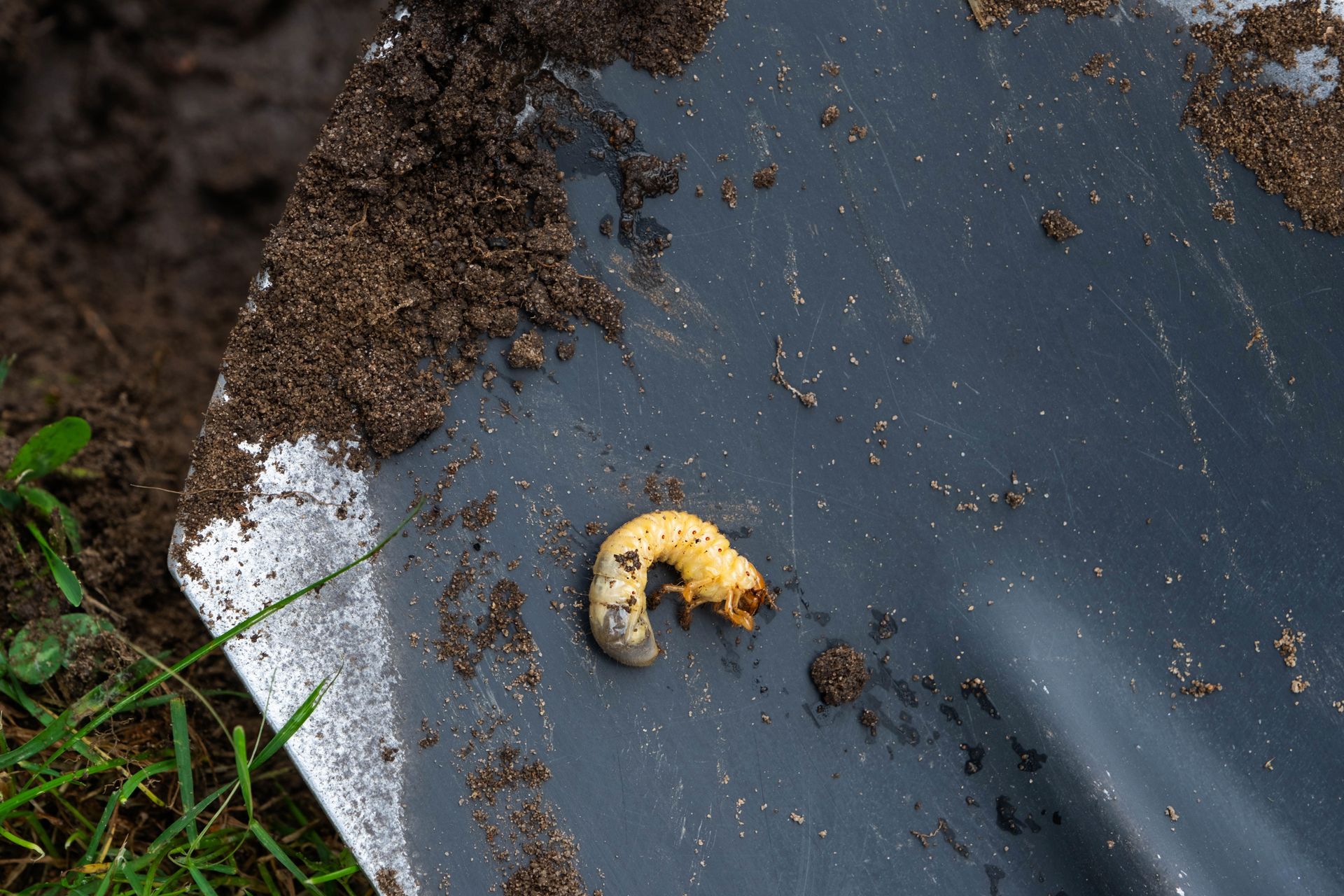
Grub damage can resemble drought stress because root damage limits the grass plant's ability to take up water.
Possible warning signs include irregular brown areas, turf that feels unusually loose, or sections of grass that lift more easily because roots have been damaged.
Brown grass alone does not confirm grubs.
Because heat stress and insect damage can look similar from above, it is important to confirm what is happening below the surface before choosing a control approach.
Homeowners who suspect root damage can learn more in our guide to signs of grubs in Missouri lawns.
7. Brown Patch and Other Summer Turf Diseases
Not every brown lawn needs more water.
Brown patch is an important disease of tall fescue in Missouri and develops under hot, humid, wet conditions. Read University of Missouri Extension's guidance on brown patch in Missouri turf.
Disease symptoms can overlap with drought and other lawn problems. Some affected lawns develop irregular or somewhat circular patches, but shape alone is not enough to make a diagnosis.
That is why automatically watering every brown patch can be the wrong response.
8. Thin or Previously Damaged Turf Under Summer Stress
Sometimes July is not when the lawn problem started. It is simply when the weakness became obvious.
Thin turf, previous insect damage, weak establishment, weed competition, shallow roots, or difficult soil conditions may all become more noticeable once summer stress increases.
A lawn in Branson or Nixa that looked acceptable during spring may begin breaking apart visually once heat exposes the weaker sections.
If large areas have permanently thinned or repeatedly fail to recover, another routine application may not address the underlying condition. Our guide to what lawn renovation actually fixes explains when a lawn may need more than fertilization alone.
What Does the Pattern of Brown Grass Tell You?
The location and shape of the browning can help narrow down what to investigate first.
| What You Notice | What It May Point To | What to Check Next |
|---|---|---|
| Large areas gradually fading | Heat stress, drought, or dormancy | Soil moisture and recent weather |
| Brown strips beside pavement | Heat and faster moisture loss | Irrigation coverage and soil conditions |
| Browning soon after mowing | Scalping or mowing stress | Cutting height and blade condition |
| Irregular patches despite moist soil | Disease, root damage, or insects | Grass blades, roots, and soil |
| Turf that lifts unusually easily | Possible root damage or grub activity | Root condition and insect presence |
| The same areas thin every summer | Compaction or weak turf | Soil conditions and root development |
The pattern is a clue, not a diagnosis. Several lawn problems can look similar from above, so the roots, soil moisture, recent weather, mowing practices, and history of the area all need to be considered together.
How Can You Figure Out What Is Actually Causing the Browning?
Before changing everything about how you care for the lawn, work through the problem one step at a time.
Start With Where the Browning Appeared
Look at the location first.
Does it follow a driveway? Is it concentrated in full afternoon sun? Is the damage limited to a heavily traveled section, or is most of the lawn gradually changing color?
A clear pattern can immediately narrow down the possibilities.
Check Below the Surface
Do not assume the root zone is moist because the top of the soil looks wet after watering.
Compare the soil in the brown area with soil beneath healthier turf. Then check whether the grass remains firmly rooted.
Loose turf may point toward root damage, while firmly rooted grass with dry soil may suggest a different problem.
Think About What Changed Recently
Consider recent weather, watering, and mowing.
Was the lawn cut shorter than usual? Did the browning appear after a prolonged stretch of heat? Did the same area struggle last summer?
A recurring pattern often tells us more than one isolated day of symptoms.
Avoid Treating Several Possible Problems at Once
When a lawn turns brown, the natural reaction is to do something immediately.
Adding more water, fertilizer, insect control, and other products at the same time can make the situation harder to understand and may add unnecessary stress.
The better approach is to identify what is most likely happening before deciding what the lawn needs.
Should You Water a Brown Lawn More?
Not automatically.
Brown grass caused by dry soil may benefit from appropriate irrigation, but grass affected by disease, severe root damage, mowing injury, or another issue will not necessarily improve simply because it receives more water.
Before increasing irrigation, check whether the soil is actually dry beneath the surface and whether sprinkler coverage is consistent.
Also pay attention to the pattern. A lawn that is uniformly wilting across exposed areas tells a different story than one isolated circular patch surrounded by healthy turf.
A watering recommendation should fit the lawn and its conditions, not simply the color of the grass.
Can a Brown Lawn Recover, or Will It Need Renovation?
Some brown lawns recover once temperatures moderate and the underlying stress is corrected. Other lawns have experienced actual turf loss and may need overseeding, rehabilitation, or more extensive renovation.
Temporary heat stress, dormancy, minor mowing injury, and correctable watering problems may leave the grass alive even though it looks rough in July.
The situation changes when there is significant turf death, widespread thinning, recurring bare areas, or severe root damage.
This is where realistic expectations matter.
Healthy lawn improvement usually happens over time rather than after one application. Our guide to how long lawn treatments take to work explains why the starting condition of the lawn and the underlying cause both affect the timeline.
When Should You Have a Lawn Professional Take a Look?
It may be time for a professional evaluation when brown areas continue spreading, the turf pulls away from the soil, reasonable watering does not improve the condition, or the same sections fail year after year.
Professional help is also useful when several causes seem possible.
AmeriLawn's application technicians are licensed through the Missouri Department of Agriculture, and our approach is built around evaluating the property before recommending a treatment plan.
For homeowners across Southwest Missouri, the goal should be to understand what the lawn actually needs instead of guessing based only on the fact that the grass is brown.
Frequently Asked Questions About Brown Missouri Lawns
Is brown grass in July dead or dormant?
Not necessarily. Cool-season grass can turn tan or brown during prolonged summer heat and drought while remaining alive at the crown and roots. The pattern of the discoloration, soil moisture, and condition of the roots can help distinguish temporary stress from permanent turf loss.
How can I tell if my lawn is brown from heat or grubs?
Heat stress often affects larger exposed areas and may cause wilting before the lawn turns brown. Grub damage can produce irregular patches and may leave turf unusually loose because the roots have been damaged. Checking the root zone is more useful than judging the lawn by color alone.
Why is my grass turning brown even though I water it?
The water may not be reaching every area evenly, compacted soil may be limiting infiltration, or the browning may not be caused by dry conditions at all. Disease, root damage, mowing stress, and intense heat can all cause discoloration even when moisture is present.
Why is the grass beside my driveway turning brown?
Grass beside driveways and sidewalks often grows under harsher conditions than turf farther into the yard. Heat, faster moisture loss, shallow soil, poor sprinkler coverage, and mowing along the edge can all contribute to these narrow brown areas.
Will brown grass turn green again when it rains?
Sometimes. Grass that is dormant or temporarily drought-stressed may recover when moisture returns and temperatures improve. Grass that has actually died from severe damage will not recover from dead tissue and may need overseeding or turf rehabilitation.
Not Sure Why Your Lawn Is Turning Brown?
Brown grass is a symptom. The right next step depends on what is causing it.
AmeriLawn helps homeowners across Southwest Missouri evaluate lawn conditions and determine whether the lawn needs a customized treatment program, grub control, weed management, aeration and overseeding, turf rehabilitation, or simply an adjustment to how it is being maintained.
If brown areas are showing up and you are not sure why, request a free lawn treatment estimate. We will look at the condition of the property and recommend what the lawn actually needs rather than adding another treatment without first understanding the problem.